Tuesday, June 8, 2010
Sunday, May 23, 2010
more images: earth air fire water
need your help...I am in the last month of finalizing pieces for my July show...need to choose an image or images for a card and etc. Which image do you feel encapsulates the thoughts of the show (statement in last post?) Also, I need some feedback on the 3 x 36x36 inch pieces....are they done/overdone/what can I do to make them cohesive, etc.?? Need your help...no feedback or art group at this time!! Thanks for your help!!
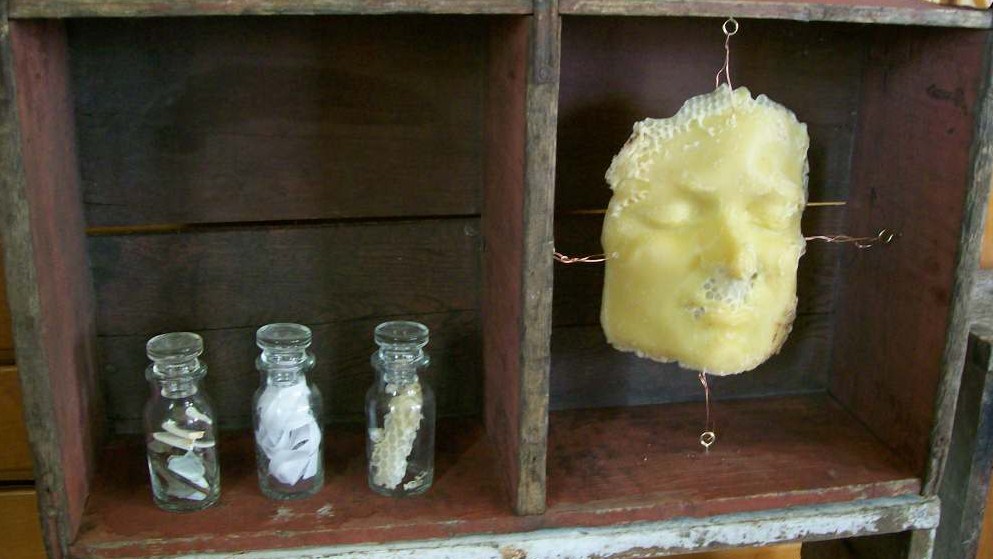
to see how the masks originated, go to http://melissa-hronkin.blogspot.com/2009/06/beeswax-mask-collaboration.html
maybe this would be a good image for the card!?
Sunday, May 16, 2010
Earth, Air, Fire, Water: Lessons from the Hive
2D and 3D explorations in mixed media and encaustics
Melissa Hronkin
Marquette Arts and Culture Center, Marquette, MI
July 1st-30th, 2010
“Our most important pollinator, the ultimate synergist, an architect, spatial genius, winged apothecary, and the transmuter of the finest substance of nectar into honey”, is the description that Rose-Lynn Fisher gives to the honeybee in the forward to her photographic book called “Bee”. “The honeybee symbolizes and embodies a congruency of form and function, vision and action, spirit and matter, all being of the same essence.” I have always been fascinated with alchemy and thinking of the artist as alchemist, and the honeybee also does this. They spin gold.
As an artist, teacher, and beekeeper, I go about my days open to the lessons my life’s work has to teach me. A fascination with bees led me to experiment and explore the art of encaustic painting, and how this relates to the content of my artwork.
This current body of work is an accumulation of 3 years of artistic exploration. It began with “Icarus Rising”, which was my symbolic return to art making after a long break from the studio, due to public school teaching. That sparked another body of work: “Wintering: Into the Hive” which was a winter show. It was an exploration of hibernation, repose, survival, and hope. Elements of each of these series appear in the current show “Earth, Air, Fire, Water.” I have taken a lot of leaps artistically and in my life. My husband and I started a honey/hive product business, we bought a historical church to operate our business out of, and this also allowed me a bigger studio space where I could try to regain my wings, and work a lot larger and installation minded.
It is always a dialogue in the studio: sometimes I lead the work, sometimes objects and elements lead me to the next sculpture or artwork. This intuitive process and being open to “chance” is where the alchemy occurs. I collect, read, and surround myself with information that seems important. Then I have to put the time in and be open to the lessons that are all around us.
I offer this work in hope, respect, and gratitude for all that I have learned from “the hive”….whether a hive of bees or students, the stings and sweat are just part of the journey. The interconnectedness of humans and nature has emerged as an important theme in this body of work. I started out trying to represent individual elements with certain pieces, but the artwork taught me that everything is connected: water is dependent upon air, earth on water, fire on earth, and so on.
“The beehive is one of the most successful ways in which the purpose of life has ever been organized….you can almost detect the purpose of life as you stand in the honey-drift downwind…if I just stand there long enough watching the bees…perhaps I’ll understand the purpose of life too”. --Verlyn Klingenborg
2D and 3D explorations in mixed media and encaustics
Melissa Hronkin
Marquette Arts and Culture Center, Marquette, MI
July 1st-30th, 2010
“Our most important pollinator, the ultimate synergist, an architect, spatial genius, winged apothecary, and the transmuter of the finest substance of nectar into honey”, is the description that Rose-Lynn Fisher gives to the honeybee in the forward to her photographic book called “Bee”. “The honeybee symbolizes and embodies a congruency of form and function, vision and action, spirit and matter, all being of the same essence.” I have always been fascinated with alchemy and thinking of the artist as alchemist, and the honeybee also does this. They spin gold.
As an artist, teacher, and beekeeper, I go about my days open to the lessons my life’s work has to teach me. A fascination with bees led me to experiment and explore the art of encaustic painting, and how this relates to the content of my artwork.
This current body of work is an accumulation of 3 years of artistic exploration. It began with “Icarus Rising”, which was my symbolic return to art making after a long break from the studio, due to public school teaching. That sparked another body of work: “Wintering: Into the Hive” which was a winter show. It was an exploration of hibernation, repose, survival, and hope. Elements of each of these series appear in the current show “Earth, Air, Fire, Water.” I have taken a lot of leaps artistically and in my life. My husband and I started a honey/hive product business, we bought a historical church to operate our business out of, and this also allowed me a bigger studio space where I could try to regain my wings, and work a lot larger and installation minded.
It is always a dialogue in the studio: sometimes I lead the work, sometimes objects and elements lead me to the next sculpture or artwork. This intuitive process and being open to “chance” is where the alchemy occurs. I collect, read, and surround myself with information that seems important. Then I have to put the time in and be open to the lessons that are all around us.
I offer this work in hope, respect, and gratitude for all that I have learned from “the hive”….whether a hive of bees or students, the stings and sweat are just part of the journey. The interconnectedness of humans and nature has emerged as an important theme in this body of work. I started out trying to represent individual elements with certain pieces, but the artwork taught me that everything is connected: water is dependent upon air, earth on water, fire on earth, and so on.
“The beehive is one of the most successful ways in which the purpose of life has ever been organized….you can almost detect the purpose of life as you stand in the honey-drift downwind…if I just stand there long enough watching the bees…perhaps I’ll understand the purpose of life too”. --Verlyn Klingenborg
Sunday, April 25, 2010
new sculptures
Friday, April 2, 2010
good friday experiments
fun with shellac and wax...and a new "be not afraid" piece...debating what to take to Babycakes!


previews of projects and fun with shellac and wax. The history of an old gramophone album or Oriental rug dye begins with a tiny insect, Laccifera lacca. Hundreds of these critters hatch out of eggs and scatter over a juicy plant or tree. Immediately, they attach their mouth to a leaf or stem to suck food and water from the host plant for the rest of their lives.
As these "scale" bugs develop from pupa to adults, they gradually excrete a sticky or waxy liquid that encases them in a cocoon. Since they'd be easy targets for predators, these scales detach from their skin and harden to protect them from pecking birds or hungry spiders. In India and Thailand, cultivators allow thousands of these insects to establish themselves on trees like the kusum, palas, and raintree.
This unusual "crop" is maintained for a season, until the time when males leave their scales and females lay new eggs. To harvest the crop, all the bits of stems and bodies and shells of insects are washed off branches to form crude lac. After much washing, filtering, and processing, this becomes seed lac and then refined shellac.
Raw shellac gets its yellow or orange tint from a dye inside the female insect's ovaries. Some woodworkers prefer an amber varnish, while other products bleach the shellac to make a clear sealant. In the past, shellac was used in tanning leather, forming records (before vinyl displaced it), and polishing wood floors. As far back as the 3rd century, people used shellac to dye fabric. Starting in the 16th century, they developed a way to paint it onto wood as a sealer.
Today, shellac covers time-release pills for oral medication, makes yellow and orange food coloring, and seals letters with wax. Since it's non-toxic and edible, other synthetic substances haven't replaced shellac. Even carpenters still value its ability to protect wood from damaging ultraviolet rays. Though it has a strong odor, varnish made from shellac dries quickly and isn't hazardous once cured. It can be used around pets and babies, finishing doors and toy chests, without fear of toxicity.
As these "scale" bugs develop from pupa to adults, they gradually excrete a sticky or waxy liquid that encases them in a cocoon. Since they'd be easy targets for predators, these scales detach from their skin and harden to protect them from pecking birds or hungry spiders. In India and Thailand, cultivators allow thousands of these insects to establish themselves on trees like the kusum, palas, and raintree.
This unusual "crop" is maintained for a season, until the time when males leave their scales and females lay new eggs. To harvest the crop, all the bits of stems and bodies and shells of insects are washed off branches to form crude lac. After much washing, filtering, and processing, this becomes seed lac and then refined shellac.
Raw shellac gets its yellow or orange tint from a dye inside the female insect's ovaries. Some woodworkers prefer an amber varnish, while other products bleach the shellac to make a clear sealant. In the past, shellac was used in tanning leather, forming records (before vinyl displaced it), and polishing wood floors. As far back as the 3rd century, people used shellac to dye fabric. Starting in the 16th century, they developed a way to paint it onto wood as a sealer.
Today, shellac covers time-release pills for oral medication, makes yellow and orange food coloring, and seals letters with wax. Since it's non-toxic and edible, other synthetic substances haven't replaced shellac. Even carpenters still value its ability to protect wood from damaging ultraviolet rays. Though it has a strong odor, varnish made from shellac dries quickly and isn't hazardous once cured. It can be used around pets and babies, finishing doors and toy chests, without fear of toxicity.
Wednesday, March 31, 2010
Subscribe to:
Posts (Atom)